
Solar panels in Madeira: what it costs, how billing works and how long it takes (2026)
Illustration
Most questions we get about solar come down to the same four: is it worth it, how does the electricity company settle it, what does it cost, and how soon can it run. Here are straight answers, with the figures that apply in Madeira in October 2026. And one thing that is rarely mentioned: in Madeira, every solar kWh saves three to six times as much CO₂ as on the mainland, because the island's grid power is that much more carbon-intensive.
Indicative prices only. The prices and savings in this article are for information and are not an offer. Your final price depends on a site survey, your roof, the cable routes and the equipment available on the island when we order. You receive a written, itemised quote before anything is agreed. Prices as of October 2026, including 22 % VAT.
How does EEM settle a home solar system?
Madeira has no net metering: you cannot store kWh in the grid and take them back later. Your system works in three steps:
- Your own use comes first. Solar power your home uses at the moment it is produced is power you do not buy, so there are simply fewer kWh on your bill.
- A battery stores the surplus for the evening and night, if you have one.
- What is left goes to the grid and can be sold. Under Despacho 240/2020, which Madeira's 2026 self-consumption decree (DLR 9/2026/M) keeps in force for now, the price is 90 % of the monthly average Iberian wholesale price (OMIE) for Portugal.
Used at home
Saves €0.18–0.21 per kWh
Stored in a battery
Used in the evening and at night (optional)
Sold to the grid
About €0.044 per kWh
A kWh you use yourself is worth 4–5 times more than one you sell.
The fixed daily power charge on your bill (potência contratada) stays the same with solar, unless the contracted power has to be raised (see the packages below). Selling the surplus is arranged separately with the supplier and also depends on the yearly quota for feeding power into the grid. If that is not available, the inverter can be set to zero export – our payback figures below include that case.
What is a kWh from your own panels worth – and a sold one?
| Value per kWh | |
|---|---|
| Bought from the grid, first 200 kWh per 30 days (4 % VAT, contracted power up to 6.9 kVA) | €0.178 |
| Bought from the grid, above that (22 % VAT) | €0.209 |
| Sold to the grid (average January–June 2026) | about €0.044 |
Every kWh you use yourself is worth four to five times more than one you sell. That is why we size systems to your own use, and why a battery often pays off. The energy price is the simple tariff from 1 October 2026 (ERSE); the sale price changes every month with the wholesale market.
How big should my system be? (the 20 % rule)
The decree (DLR 9/2026/M, article 7) allows a system whose estimated yearly production is no more than 20 % above your average yearly use over the last 12 months. So the starting point is your bills: send us the last 12 months (bills from the last two years or smart-meter data also count). If there is no history yet, for example in a new home, a reasoned estimate is accepted. We check the 20 % limit with a deliberately high yield (1,700 kWh per kWp a year), so your system stays within the rule even in a very sunny year. With a battery, a larger system may be possible in justified cases, with technical justification and a favourable opinion from the grid operator (article 7(5) and (9)).
What does it cost? Packages and indicative prices
Four sizes for typical homes: S without a battery; M, L and XL with or without one. Prices are rounded up and include 22 % VAT, delivery to the island, mounting on a pitched tiled roof, installation, commissioning and the DREN paperwork.
Indicative prices, not an offer. We confirm the final price in a written quote after the site survey.
| Package | Yearly use | System | Price from | Saving in year 1 | Payback |
|---|---|---|---|---|---|
| S | 2,150–3,550 kWh | 1.5 kWp (3 panels), microinverter | €2,500 | about €230 | 10–16 years |
| M¹ | 3,550–5,000 kWh | 2.5 kWp (5 panels), 3.6 kW hybrid inverter | €3,900 | about €390 | 9–16 years |
| M + battery | 3,550–5,000 kWh | M + 5 kWh battery | €5,100 | about €530 | 9–11 years |
| L | 5,000–6,400 kWh | 3.5 kWp (7 panels), 3.6 kW hybrid inverter | €4,300 | about €560 | 7–10 years |
| L + battery | 5,000–6,400 kWh | L + 10 kWh battery | €6,700 | about €820 | 7–9 years |
| XL | over 6,400 kWh | 4.5 kWp (9 panels), 3.6 kW hybrid inverter | €4,700 | about €720 | 6–9 years |
| XL + battery | over 6,400 kWh | XL + 16 kWh battery | €7,300 | about €1,090 | 6–7 years |
| XL Power | over 6,400 kWh | 4.5 kWp, 6 kW hybrid inverter, 16 kWh battery, production meter | €8,200 | about €1,090 | 7–8 years |
Download the solar price guide 2026 (PDF, 4 pages)
¹ M is for roofs without shade only (a technical limit of the five-panel string).
How we calculated: south-facing roof at about 30°, no shade; 1,500 kWh per kWp a year (PVGIS: ten south-coast locations from Calheta to Machico average 1,510, ranging from 1,340 to 1,621); yearly use of 2,500 / 4,000 / 5,500 / 7,000 kWh; the simple tariff from 1 October 2026. The payback range comes from three scenarios: electricity +2 % a year with the surplus sold; unchanged price with the surplus sold; +2 % a year without selling. It includes the hybrid inverter's own consumption, 0.5 % panel ageing a year and an inverter replacement in year 13; as a precaution we reduce the battery's estimated extra benefit by a further 15 % (2 % capacity loss a year, 15-year life, no battery benefit after year 15). In a conservative scenario – the price does not rise and no surplus is sold – payback is longer: about 19 years (S), 18 (M), 14 (M + battery), 14 (L), 9 (L + battery), 9 (XL), 8 (XL + battery) and 9 (XL Power). Even that is not the worst possible outcome. No grant is included. On the north coast and in higher, cloudier places the yield can be noticeably lower – we calculate your exact location.
Contracted power: we choose the inverter so it does not exceed your contracted power, as Despacho 240/2020 required. So a 3.6 kW inverter needs at least 4.6 kVA, the 6 kW one 6.9 kVA. Going from 3.45 to 4.6 kVA costs about €39 a year more, VAT included; going to 6.9 kVA costs about €90 a year more from 3.45 kVA, or €51 from 4.6 kVA. These costs are not in the payback figures.
A worked example: is it worth it for you?
You decide. Here is the full calculation for one home, so you can see where the 7–10 years for the L package come from, with no grant.
The home: south coast, 5,500 kWh a year, single-phase, 4.6 kVA. The system: L package, 3.5 kWp (7 panels), 3.6 kW hybrid inverter, no battery, €4,300.
About 5,250 kWh of solar a year – without a battery the home uses about 42 % directly
5,250 kWh produced, 2,210 kWh used directly, home uses 5,500 kWh a year
- Used directly
- Sold to the grid (about €0.044/kWh)
- Home's monthly use
| 2026 | Used directly | Sold to the grid (about €0.044/kWh) | Home's monthly use |
|---|---|---|---|
| Jan | 160 | 182 | 495 |
| Feb | 159 | 195 | 454 |
| Mar | 183 | 282 | 467 |
| Apr | 195 | 290 | 440 |
| May | 206 | 304 | 433 |
| Jun | 208 | 282 | 426 |
| Jul | 215 | 321 | 440 |
| Aug | 210 | 327 | 454 |
| Sept | 181 | 271 | 433 |
| Oct | 170 | 249 | 454 |
| Nov | 155 | 186 | 467 |
| Dec | 165 | 153 | 536 |
L package (3.5 kWp), south-coast PVGIS average, hourly simulation
| Step | Value |
|---|---|
| Production in a year (3.5 kWp × 1,500 kWh/kWp, PVGIS) | 5,250 kWh |
| Used in the home as it is produced | about 2,200 kWh |
| Sold to the grid | about 3,040 kWh |
| Energy bill without solar (5,500 kWh) | €1,076 |
| Energy bill with solar (incl. the inverter's own consumption, about 175 kWh a year) | €651 |
| Saving on the bill | €425 |
| Income from the surplus (3,040 kWh × €0.044) | €134 |
| Benefit in year 1 | €559 |
| Simple payback (€4,300 ÷ €559) | 7.7 years |
In reality, three things move this figure. If electricity rises 2 % a year, it is 7.4 years; if prices stay the same, 7.8 years; if you cannot sell the surplus, 9.5 years. All three include 0.5 % panel ageing a year and an inverter replacement in year 13. That is why we quote 7–10 years for L. If the price does not rise and you cannot sell the surplus (conservative scenario), it is about 14 years. Over 25 years, depending on these four scenarios, the system returns about €4,500–10,500 more than it cost (in nominal euros, not discounted).
The L package pays back in 7–10 years
Cumulative cash flow: 3.5 kWp, 5,500 kWh a year, €4,300, inverter replaced in year 13
- Electricity +2 % a year, surplus sold: pays back in 7.4 years, +€10,459 after 25 years
- Unchanged prices, surplus sold: pays back in 7.8 years, +€7,706 after 25 years
- Electricity +2 % a year, no surplus sold: pays back in 9.5 years, +€7,312 after 25 years
| years | Electricity +2 % a year, surplus sold | Unchanged prices, surplus sold | Electricity +2 % a year, no surplus sold |
|---|---|---|---|
| 0 | -4,300 € | -4,300 € | -4,300 € |
| 1 | -3,741 € | -3,741 € | -3,874 € |
| 2 | -3,176 € | -3,184 € | -3,443 € |
| 3 | -2,605 € | -2,631 € | -3,004 € |
| 4 | -2,029 € | -2,080 € | -2,559 € |
| 5 | -1,446 € | -1,532 € | -2,108 € |
| 6 | -858 € | -987 € | -1,650 € |
| 7 | -263 € | -444 € | -1,185 € |
| 8 | 338 € | 96 € | -713 € |
| 9 | 945 € | 633 € | -234 € |
| 10 | 1,559 € | 1,167 € | 253 € |
| 11 | 2,179 € | 1,699 € | 746 € |
| 12 | 2,807 € | 2,228 € | 1,247 € |
| 13 | 2,275 € | 1,589 € | 589 € |
| 14 | 2,916 € | 2,113 € | 1,105 € |
| 15 | 3,564 € | 2,635 € | 1,628 € |
| 16 | 4,219 € | 3,153 € | 2,160 € |
| 17 | 4,882 € | 3,669 € | 2,699 € |
| 18 | 5,551 € | 4,183 € | 3,246 € |
| 19 | 6,229 € | 4,694 € | 3,801 € |
| 20 | 6,914 € | 5,202 € | 4,365 € |
| 21 | 7,607 € | 5,708 € | 4,937 € |
| 22 | 8,308 € | 6,211 € | 5,518 € |
| 23 | 9,017 € | 6,712 € | 6,107 € |
| 24 | 9,734 € | 7,210 € | 6,705 € |
| 25 | 10,459 € | 7,706 € | 7,312 € |
The same with a 10 kWh battery: €6,700; the energy bill drops from €1,076 to €227; the year-1 benefit is about €820, because as a precaution we reduce the battery's estimated extra benefit by 15 %; payback 7–9 years. For your own home we run the same calculation in PVGIS for your exact location, orientation and tilt, using your own last 12 months of bills.
How much CO2 does it save?
In Madeira, one kWh from the grid comes with about 0.5 kg of CO₂ equivalent. According to the Portuguese Environment Agency (APA), it was 0.511 kg in 2023 and 0.497 kg on average over 2019–2023. On the mainland the figures were 0.092 kg and 0.156 kg. So every solar kWh here, whether you use it or sell it, replaces three to six times as much CO₂ as in Lisbon.
| Package | Production a year | CO₂ avoided a year |
|---|---|---|
| S | 2,250 kWh | about 1.1 tonnes |
| M | 3,750 kWh | about 1.9 tonnes |
| L | 5,250 kWh | about 2.6 tonnes |
| XL | 6,750 kWh | about 3.4 tonnes |
Over 25 years, the L package avoids about 60 tonnes of CO₂ at the 2019–2023 Madeira grid average. As the island uses more renewable power, that figure will fall. Making the panels takes energy too, but in a sunny location a system earns it back in about a year (Fraunhofer ISE).
Which panels, inverter and battery do you use?
We do not tie the packages to one brand. What can be bought and shipped to Madeira changes from month to month, so we work to a minimum specification. Your written quote names the exact models, with datasheets and certificates.
- Panels: monocrystalline (TOPCon) modules of about 500 W, with a performance warranty of at least 25 years.
- Inverter: single-phase hybrid inverter of 3.6 kW (6 kW for XL Power), battery-ready, with export limiting and an optional backup output. It meets the European standards the decree requires and Madeira's grid code. The S package uses a microinverter.
- Battery: lithium iron phosphate (LiFePO4), typically with a 10-year manufacturer warranty.
If a component is not available, we offer one with the same or a better specification and tell you before ordering. The inverter's power class does not change, because it decides the paperwork and the meter.
How long from contract to switch-on?
For a home system with up to 4 kW of inverter output, typically 5–7 weeks. The longest part is the legal waiting period, not the installation.
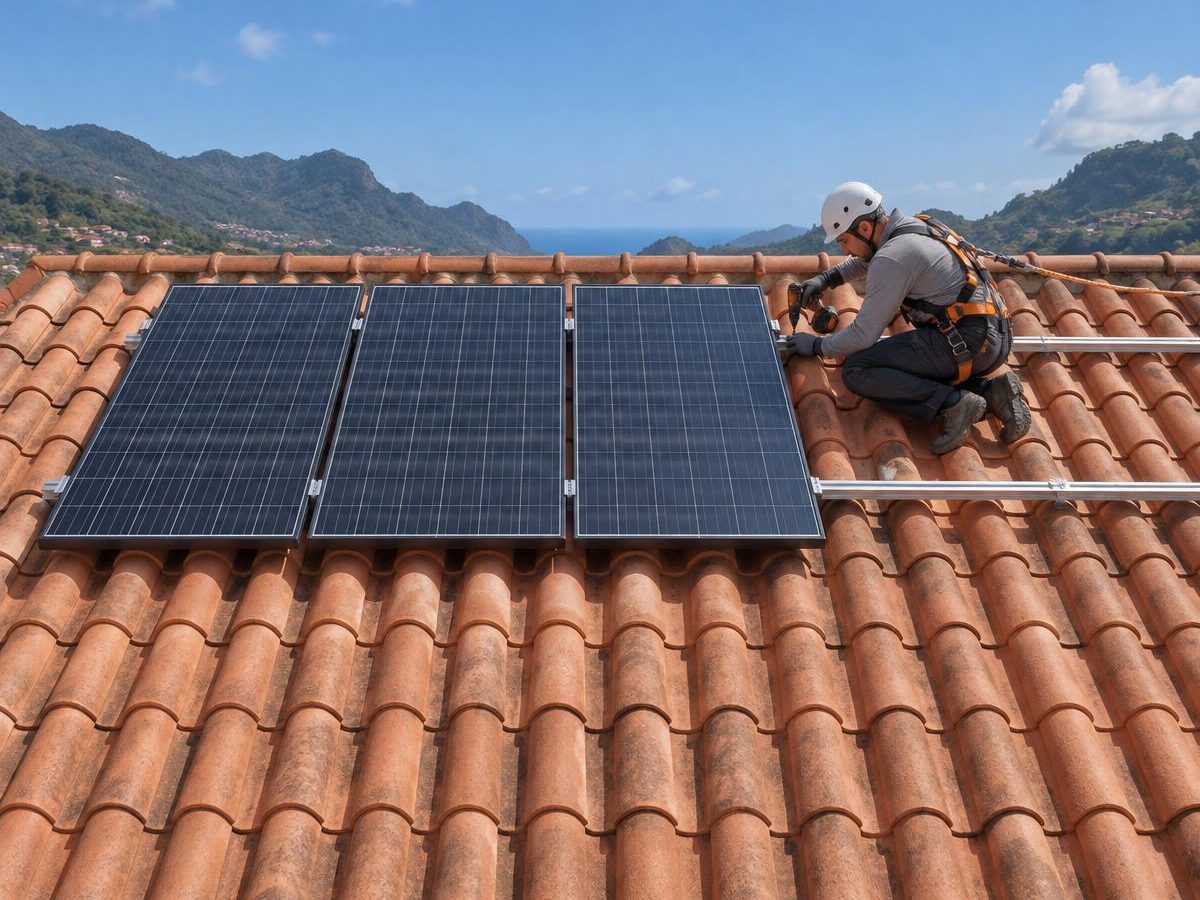
- Survey and quote (before the contract). We look at the roof, the electrical board and your bills, and calculate the yield with PVGIS.
- Notice to DREN (week 1). Systems above 700 W need a prior notice (comunicação prévia) to the regional energy directorate, free of charge up to 30 kW. We prepare the documents; the notice is filed in your name as the self-consumer (the holder of the electricity contract).
- 30-day waiting period. DREN can refuse the notice within 30 days. If it does not, the notice counts as confirmed (DLR 9/2026/M, article 34); switch-on also requires the technical and metering requirements to be met.
- Materials (at the same time). Delivery to the island usually takes 3–4 weeks, sometimes longer.
- Installation: 1–2 days. Usually during the waiting period, so we can switch on as soon as it ends.
- Commissioning and handover. We set up the system and the app and show you how to follow your production.
Above 4 kW of inverter output, as with XL Power, a production meter with remote reading is also required (article 23); its cost is included in the XL Power price. If your home's own meter is not suitable, EEM has to install a suitable one within 4 months of the request, or within 45 days on a paid urgent request (article 23(7)). Above 6.9 kW, an inspection before switch-on is also required. Selling the surplus is arranged separately; until it is set up, the system can run with zero export.
Do I need a battery?
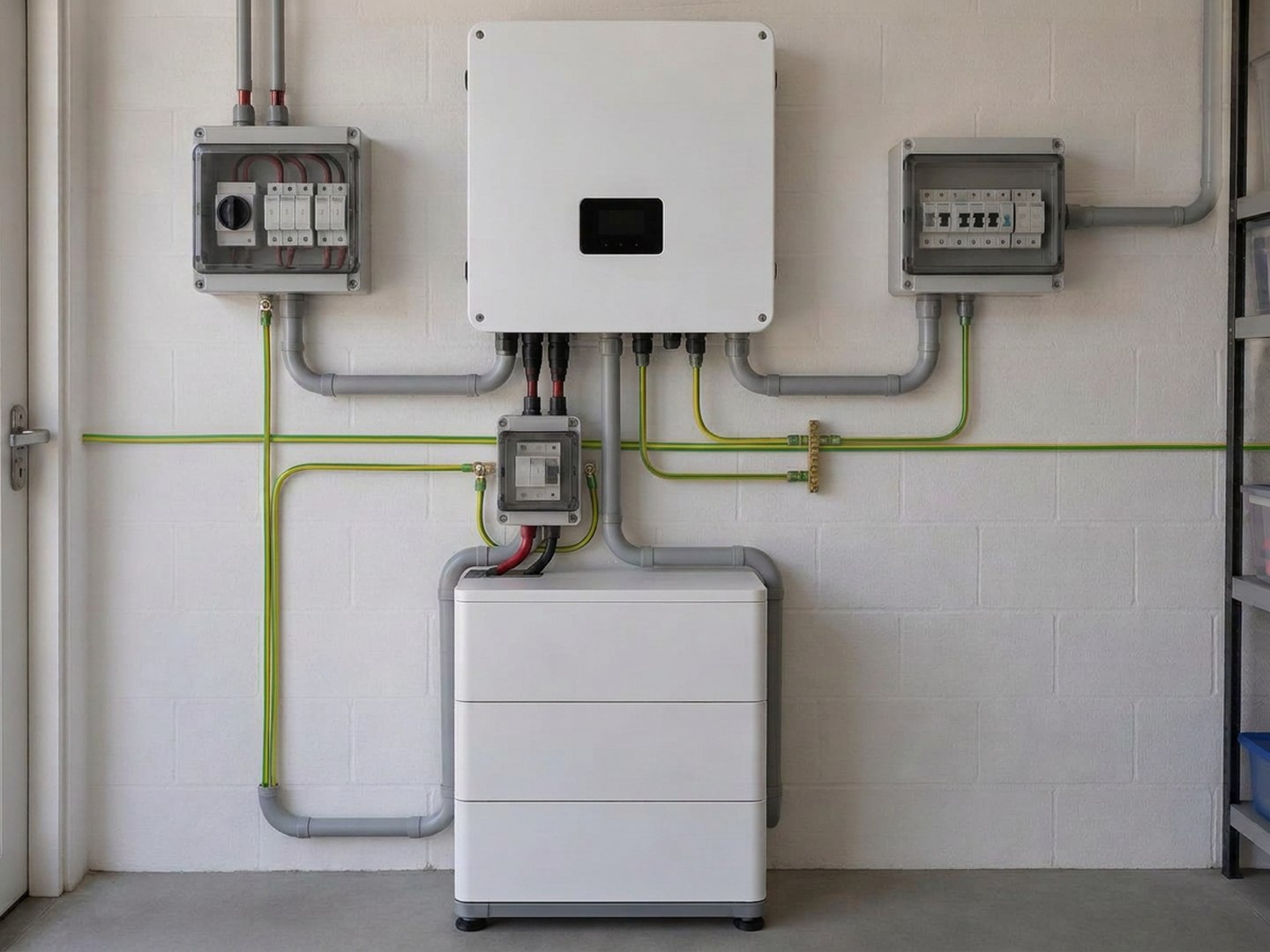
Without a battery, much of the midday surplus is sold at about €0.044. A battery moves it to the evening, where it replaces power that costs €0.18–0.21. In our calculation, the battery versions pay back at most about a year later than the same system without one (M even sooner), and depend far less on the sale price. A battery on its own does not give backup power in a power cut (see below).
My home is single-phase and the power trips. Do I need three-phase?
Not always. Contracted power above 6.9 kVA costs more every year: about €77 more for 10.35 kVA and about €154 more for 13.8 kVA three-phase, VAT included. Above 6.9 kVA the 4 % VAT on the first 200 kWh no longer applies either, which can add up to about €75 a year. Three-phase also means a one-off rewiring cost. A hybrid inverter with a battery can cover short peaks instead: a 6 kW inverter with a 16 kWh battery can add up to 6 kW for about 2.4 hours on a full battery. If your home needs more than 6.9 kVA for hours at a time (heating, oven and air conditioning together), an upgrade can still be the right choice. We calculate both options for you.
Will it work in a power cut?
Only if it is built for it. A standard grid-tied system switches off when the grid fails, for safety. Backup needs a hybrid inverter with a backup (EPS) output, a battery and an automatic changeover, and it supplies only the circuits connected to it, such as lights, fridge, router and selected sockets. This is an extra and is not included in the package prices.
Are there grants, and what VAT applies?
The prices include 22 % VAT. The regional +ENERGIA programme's application period for panels and batteries closed on 29 August 2025 (the original 30 May deadline was extended); at the time of writing (October 2026) there is no open call – the 2026 budget increase only pays applications from 2025. Our prices and payback figures assume no grant. If a new call opens, we will tell you.
How to check a solar offer
Four quick checks for any offer, from any company:
- Production may exceed your use by no more than 20 %. If an offer promises twice as much production as your home uses, the system is larger than Madeira's decree allows (DLR 9/2026/M, article 7).
- The yearly saving cannot be higher than your current energy bill. If an offer promises more, the calculation is wrong.
- The yield should be for your exact site. PVGIS is free, and even on the south coast it gives about 1,340 to 1,620 kWh per kWp, depending on the spot and the shading. Ask which location, tilt and shading the offer used.
- It should follow Madeira's rules. In Madeira, DLR 9/2026/M and DREN apply. An offer that only mentions the mainland's DGEG procedure was probably not written for Madeira.
Also ask who registers the system with DREN, how many years the installation warranty runs, and whether the production meter (above 4 kW) is included.
What do we take care of, and what is left for you?
We handle: the survey and yield calculation; sizing to the 20 % rule; the documents for the DREN notice; supplying the equipment; installation by a qualified responsible technician or a DREN-registered electrical installer, as the decree requires (article 25); commissioning and the app; the production meter where needed; help with the surplus-sale contract.
You: sign the DREN notice as the self-consumer (the holder of the electricity contract); take out civil liability insurance for the system, which the decree requires (article 16) – often an add-on to your home insurance, so ask your insurer; and, for a shared roof, notify the condominium administration in writing at least 20 days before installation; it may object within 20 days on specific grounds (article 13).
Sources
- DLR 9/2026/M – Madeira self-consumption regime
- Despacho 240/2020 – price for surplus solar power in Madeira
- ERSE Directive 4/2026 – electricity tariffs from 1 October 2026
- APREN – electricity market bulletin, June 2026
- Tax Authority – VAT rates in Madeira (Ofício-Circulado 25045/2024)
- PVGIS – EU Joint Research Centre
- APA – Electricity emission factor 2025
- Fraunhofer ISE – Photovoltaics Report
- IDR Madeira – +ENERGIA programme